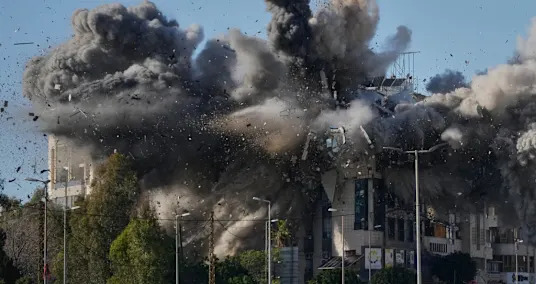
The US-Israel war on Iran and its ripple effect throughout the Middle East have had a devastating impact on Arab countries, with millions expected to slide into poverty, according to the United Nations.
A UN Development Programme (UNDP) report published on Tuesday said that gross domestic product (GDP) in the region was estimated to decline by approximately 3.7 to 6 percent after a month of war, equivalent to a contraction of $120bn to $194bn.
Abdallah Al Dardari, UN assistant secretary-general and director of the UNDP Regional Bureau for Arab States, said that 3.7 million jobs will be lost and about four million more people in the region could fall below the poverty line, noting that the war had highlighted the “fragility in the Arab economy”.
The report was based on projections of “a short but intense conflict lasting for four weeks”, signalling that the impact of the war, which has seen Iran attacking Gulf energy infrastructure and squeezing oil and gas exports through the Strait of Hormuz, will likely be even higher if it drags on longer.
Issued as tight oil supplies pushed Brent crude futures up 4.7 percent to more than $118 per barrel, the report said, “risks in strategic maritime corridors” had “knock‐on effects on inflation, trade flows, and global supply chains” that could undermine livelihoods in the Middle East’s “interconnected economies”.
It added that increases in poverty rates were “concentrated in the Levant and fragile countries (Sudan and Yemen), where baseline vulnerability is highest and shocks translate more strongly into welfare losses”.
The report noted that Lebanon, dragged into the war after Hezbollah struck Israel in retaliation for the US-Israeli killing of Iran’s Supreme Leader Ayatollah Ali Khamenei on February 28, is especially impacted, with “ongoing air strikes and evacuation orders … already causing widespread destruction of residential areas, transport infrastructure, and public services, alongside large‐scale displacement”.
“We hope the fighting will stop tomorrow, as every day of delay has negative repercussions on the global economy,” said Al Dardari.
LATEST POSTS
- 1
 Astronomers discover never-before-seen celestial object: "Cloud 9"
 - 2Travel Through France's Most Iconic Wine Regions By Train On An Immersive Seven-Day Journey
- 3Venice’s newest marvel is a wild, acrobatic dolphin. His refusal to leave puts him in danger
- 4Whale stranded off Germany for days is stuck again
- 5Clocks to go forward one hour in Europe as summer time starts




- UAE recalls some Nestle infant formula products, Qatar warns consumers
- Over 1,800 killed since junta seized power in Burkina Faso, rights group says
- Tatiana Schlossberg's diagnosis puts spotlight on leukemia: What to know
- Luigi Mangione‘s lawyers say Bondi’s death penalty decision was tainted by conflict of interest
- Oil, energy and food: Which countries in Europe are most exposed to higher food prices?
- The Artemis II launch is tonight. Here's how to watch it live.
- Inside The Design-Forward Wellness Hotel Marking A New Chapter In Medellín
- Toddler diagnosed with cancer makes remarkable recovery after aggressive treatment
- Judge approves Purdue Pharma’s new $7B opioid settlement with the Sacklers